Most Back Bay sellers walk into a listing conversation with a median price and a wish. Both are the wrong starting point. The number that will actually determine your net proceeds this year is not on any portal. It sits in a Back Bay Architectural Commission file, on the second page of your master deed where parking is defined, and inside a sub-market split that treats a Beacon Street trophy and a Hereford Street two-bed as the same asset when they are not.
This post is for owners preparing to list a brownstone condo between now and fall 2026, and for the buyers' agents who will read the offering package. The three frictions below are the ones that consistently reprice a Back Bay deal after the listing photos go live. Handle them before the sign goes up and you keep the premium. Handle them at the closing table and you give it back.
The BBAC violation record is the diligence document nobody plans for
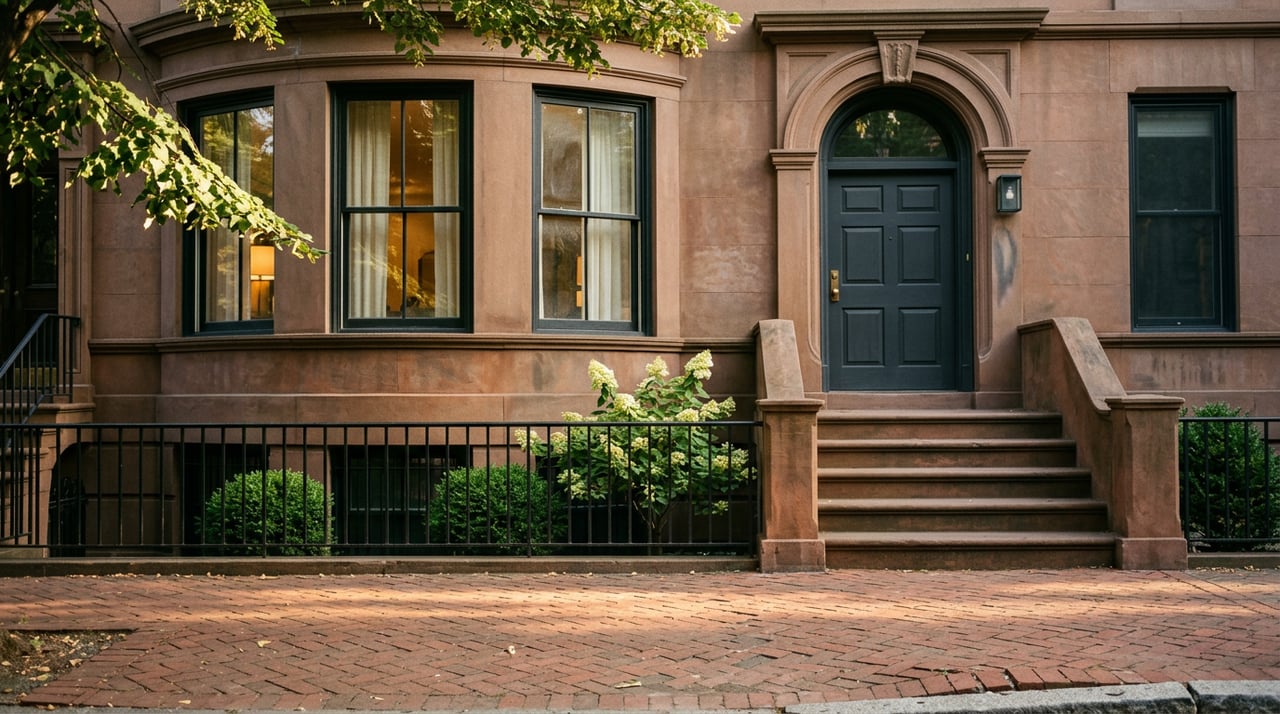
Every exterior change to a Back Bay building has needed Commission approval since 1966. The district was designated that year and expanded three times through 1981, and the current framework requires a Design Approval Application before any exterior work begins, with a decision letter that must be in hand before the building department will issue a permit. You can read the process directly on the City of Boston's Back Bay Architectural District page.
That framework has been in place long enough that most brownstones now carry a paper trail. Some of that trail is clean. Some of it is not. The Commission's January 14, 2026 hearing docket, published in the Winthrop Transcript, opened with a violations subcommittee reviewing three addresses that had already been continued from December:
- 72 Commonwealth Avenue — unapproved masonry repairs at the front facade
- 416 Marlborough Street — unapproved lattice wood enclosure at the street
- 345 Beacon Street — unapproved masonry work at the front facade and unapproved tree removal and landscape work in the front garden
None of those items are exotic. They are the exact projects a well-meaning owner or trustee approves on their own: repointing that looks like maintenance, a wood screen off the sidewalk, a dying tree replaced without a filing. The Commission's rule is straightforward and quietly punishing: no application for a Certificate of Appropriateness will be approved while an outstanding architectural violation exists on the building. If your unit sits above one of those violations, your buyer's attorney will find it, and your buyer's lender may not close on a property with an open enforcement action.
Two rules catch sellers off guard more than any others. First, mechanical penetrations are not allowed on front or rear facades, which means the mini-split condenser a prior owner mounted on the back wall is a violation, not a feature. Second, when the Commission reviews a change to a condominium, the entire building is considered and treated uniformly, so a single-unit window swap can pull the whole facade into review. Those two rules alone drive most of the last-minute repricing I see in this district.
The practical read: pull the BBAC file for your building before you list, not after an offer. A staff pre-consultation is free, and the Commission meets the second Wednesday of every month, which means a violation caught in July can plausibly clear before an October closing. A violation caught in September cannot.
The neighborhood median hides a two-to-one spread
Back Bay reported a single-family median of $1,550,000 in March 2026 and an average sale price of $2,482,793 across a market averaging 62 days on the market. Zillow's home value index for the same window sat at $1,337,259, down 1.7% year over year. Both numbers are directionally useful and strategically useless.
The real pricing signal is the sub-market split. Redfin's April 2026 submarket data, aggregated by a local buyer's guide, priced the neighborhood roughly like this:
| Sub-market | Active condos | Median list | Days on market |
|---|---|---|---|
| Back Bay East | 39 | $2.27M | 43 |
| Back Bay West | 42 | $1.05M | 51 |
| Prudential–St. Botolph | 27 | $1.73M | 40 |
Two-plus times the median list price between East and West, in the same neighborhood, in the same month. A seller anchored to the neighborhood-wide $1.55M number will underprice a Marlborough parlor floor near the Public Garden and overprice a two-bed near Hereford Street. Ford Realty's Q1 2026 read of the same market recorded a range of $1,579 to $1,627 per square foot with days-to-offer between 66 and 108, except for "hot homes" carrying parking, outdoor space, or direct elevator access, which typically cleared inside 25 days. That last carve-out is the entire pricing conversation compressed into one sentence.
The mechanism underneath the spread is straightforward. Back Bay East draws the trophy buyer paying for a specific address on Beacon or Commonwealth. Back Bay West draws the professional buyer who wants the neighborhood at a workable price per square foot. Prudential–St. Botolph draws the amenity buyer who wants central air, in-unit laundry, and a doorman. Three buyer profiles, three pricing behaviors, one median that describes none of them.
Parking is a line item, not a bullet point
The single largest comp adjustment in Back Bay is not the kitchen. It is the parking, and its status is more consequential than its existence.
A deeded or assigned garage space in Back Bay often carries a larger premium than many interior upgrades, and standalone spaces continue to list in the six figures.
Standalone deeded spaces at The Somerset garage are currently offered in the $150,000 to $200,000 range, sold individually or as a package, and a separate deeded space behind 377 Commonwealth Avenue is being marketed on its own. Historical sales in the district have cleared above $300,000 for a single dedicated spot and above $500,000 for a tandem pair, though those figures predate the current cycle and should be read as directional. What matters for a 2026 listing is the delta, not the absolute number.
Three questions decide how that delta gets priced into your unit:
- Is the space deeded to the unit, or is it a common-area right assigned by the trustees and revocable?
- If it is deeded, is it a defined space, a floating right within the garage, or a tandem obligation shared with another unit?
- Is the space accessible directly from the building, or is it a leased spot in a neighboring garage that transfers as a contract right?
Buyers' attorneys will pick that language apart during the offer-to-P&S window, and the lender's appraiser will apply a different adjustment for each answer. Two 1,400-square-foot two-bedrooms on Beacon Street with different parking language are not the same asset, and pricing them as if they were is how a Back Bay seller leaves $75,000 to $200,000 on the closing statement.
Storage assignments behave the same way. A deeded cage in the basement is worth stating in the MLS. An informal understanding among trustees is worth stating in the offering package and nowhere else.
A pre-listing sequence that respects the district
The order matters because the BBAC calendar is monthly and MGL Chapter 183A diligence is document-heavy. This is the sequence I use with sellers targeting a summer or early-fall 2026 close:
- Pull the BBAC file for the building, not just the unit. Look for open violations, expired Certificates of Appropriateness, and any 2023–2025 approvals with conditions the building did not fully meet.
- Reconcile the master deed against physical reality. Confirm parking language, storage assignments, exclusive-use areas, roof rights, and any easements. Reconcile them against what the unit actually uses today.
- Order the standard 183A packet early: current budget, most recent reserve study, twelve months of meeting minutes, assessment history, insurance summary, and the certificate of occupancy if the building is a conversion.
- Stage the mechanicals conversation before the listing photos. If a prior owner installed a facade-mounted condenser, a non-compliant window, or a rear addition without approval, decide with counsel whether to cure, disclose, or price for it. All three are defensible. Silence is not.
- Price to the sub-market, not the neighborhood. East, West, and Prudential–St. Botolph are three different auctions. Anchor to closed sales in the same sub-market with the same parking status, then adjust.
- Time the listing to the BBAC calendar if any exterior work is expected to be a condition of sale. The Commission meets the second Wednesday of each month, and Certificates of Appropriateness are valid for one year.
Sellers who run this sequence tend to sign a P&S with fewer contingencies and shorter diligence windows. Sellers who skip it tend to renegotiate at the eleventh hour.
Short FAQ
Does the BBAC review interior work? Generally no. The Commission's jurisdiction is exterior changes visible from a public way, though some Boston buildings are separately landmarked with interior protections. Interior alterations that would require new exterior egress features, such as a rear balcony, do pull the exterior work into review.
Can I install central air in a brownstone unit? You can, but the equipment cannot penetrate the front or rear facade. Compliant installations route condensers and venting through the roof, which affects both cost and shared-common-area consent from the trustees. That constraint is one reason full-service towers with central HVAC price at a different multiple than brownstone conversions.
How long does a BBAC approval actually take? Straightforward, in-kind projects such as an in-kind window replacement or membrane roof replacement are frequently placed on the administrative approval list and cleared at the monthly hearing without a full design review. The January 2026 docket showed exactly that pattern at 273 Beacon, 148, 190, 256, 296, 328, and 333 Commonwealth. Anything requiring design review, or anything with an existing violation on the building, should be planned in months, not weeks.
If you own a Back Bay condominium and are thinking about a 2026 listing, the work that protects your price starts before the professional photos. Eric Glassoff can review your building's BBAC file, reconcile your parking and storage language against the master deed, and price your unit against the sub-market that will actually decide the offer. Schedule a free neighborhood consultation to walk through the file before your listing goes live.