Pull up any portal and Brookline's condo market looks legible. Q2 2026 MLS PIN sold data puts the median condo at $999,999, closing at 100% of list price in a median of 51 days. Set that next to the Brookline single-family median of $2,850,000 and the condo lane reads like the sensible on-ramp into the town's schools, transit, and walkable villages.
The closing statement tells a different story. Between the May 5, 2026 override, a residential exemption that only helps owner-occupants, and a housing stock where more than half of all units predate 1939, two Brookline condos listed at the same price can carry monthly costs that diverge by hundreds of dollars, sometimes more. The thesis of this post is simple: the median is the least useful number in a Brookline condo purchase this year. The numbers that matter show up in the 6(d) certificate, the reserve study, and the phased override math, and none of them are visible before you write an offer.
The friction hits at the signing table, not the showing
Every Brookline condo transaction pivots on a document most buyers hear about only after their offer is accepted: the Section 6(d) certificate. Under Massachusetts General Laws Chapter 183A, the association's trustees have to sign a statement confirming whether any common charges, special assessments, fines, or fees are outstanding on the unit. Lenders will not fund without a clean one, and the certificate can take several weeks to obtain if the association is self-managed or the trustees are hard to reach.
The 6(d) is a snapshot of one unit's ledger. The document buyers should be asking for alongside it is the association's most recent reserve study, its 12 to 24 months of board meeting minutes, and its master insurance declarations. That packet is where a $999,999 condo becomes either a stable purchase or a leveraged bet on a boiler.
What the same list price actually buys
Three condos priced within a few thousand dollars of the Q2 median can produce very different total monthly costs. The table below sketches the pattern using representative Brookline configurations. Individual buildings will vary, and every buyer should model their own numbers against the actual condo documents.
| Configuration | Typical monthly HOA | Reserve posture | FY2026 tax posture |
|---|---|---|---|
| Pre-1939 brownstone conversion, 4 to 8 units, self-managed, Coolidge Corner or Washington Square | Lower fee, often heat and hot water included via a shared system | Frequently thin; boiler, roof, and masonry cycles all approaching at once | Full bill, minus $354,974 residential exemption if owner-occupied |
| Mid-century elevator building, 40+ units, professionally managed | Higher fee covering staff, elevator service contracts, master insurance, and reserve contributions | Often funded closer to the 10% of operating revenue benchmark lenders look for | Same tax mechanics, but assessed values per unit tend to be lower per square foot |
| Any of the above, purchased as a rental | Same fee as owner-occupant | Same reserve exposure | No residential exemption; full assessed value taxed at $10.24 per $1,000 |
The residential exemption is the quiet lever. In Brookline it reduces the taxable value of an owner-occupied primary residence by $354,974, and it does not apply to investment units. On a condo assessed at $900,000, that difference alone changes the annual tax bill by roughly $3,600 before the override even phases in.
The override changes the denominator on every affordability calculation
On May 5, 2026, Brookline voters approved the $23.25 million operating override by 8,675 to 5,732, a nearly 20-point margin on the highest turnout ever recorded in a local Brookline election. About $17.9 million of the new revenue goes to the Public Schools of Brookline and roughly $5 million to town departments. The Town of Brookline's FY2027-2029 Override Guide lays out the phase-in schedule. The practical translation, in the reporting from local coverage, is that property taxes will rise about 18% over three fiscal years, compared with about 11% had the override failed.
That climbs onto a base most portals never show. Brookline's FY2026 residential rate of $10.24 per $1,000 sits well below the state's $14.58 average. Median assessed values close to $2.3 million push the average single-family tax bill to $26,237, which, according to state figures reported by Brookline.News, is the second-highest in Massachusetts, trailing only Weston's $26,313. Condo owners pay the same rate on their own assessed value, so a $900,000 owner-occupied condo assessment currently produces roughly a $5,600 tax bill before the phase-in. Add three years of 18% cumulative growth and the same unit is closer to $6,600 by FY2029, assuming the assessment itself does not move. Assessments usually do move.
The mortgage math is more forgiving than it was. Freddie Mac's Primary Mortgage Market Survey put the 30-year fixed at 6.47% the week of June 18, 2026, down from 6.81% a year earlier. On a $700,000 loan that is roughly $155 less in monthly principal and interest. The tax phase-in eats a meaningful piece of that relief.
Why building age is doing more work than any single number
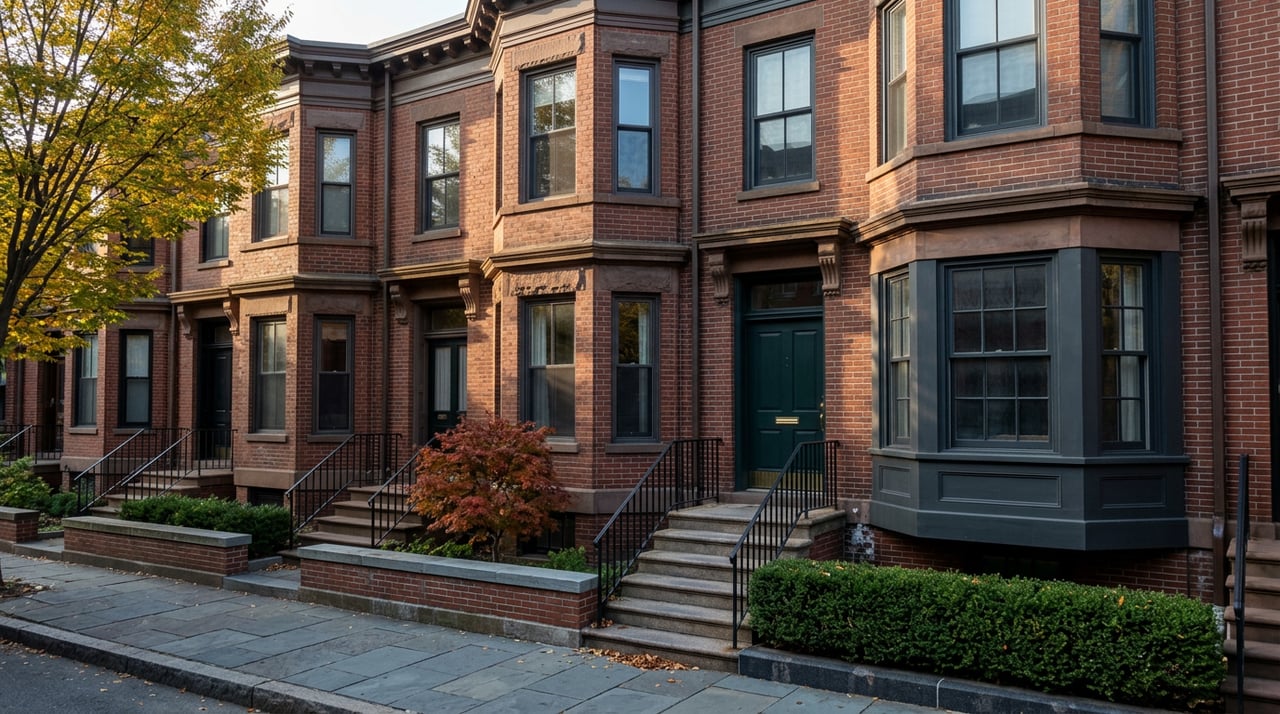
Brookline's 2024 housing report documented that 53% of housing units are in buildings built before 1939, with another 17% built between 1940 and 1959 and 20% between 1960 and 1979. That is the physical backdrop against which every reserve study should be read.
Two Boston-area cases still cited by real estate attorneys illustrate the tail risk. In 2006 the Brook House assessed roughly $50,000 per unit toward a $38 million heating system replacement. A year earlier, the association at 50–60 Longwood Avenue levied a special assessment averaging around $160,000 per condo to address garage flooring, brick exterior, and emergency generator work. Both were older buildings whose capital cycles arrived faster than reserves could absorb. Both were, at the time of purchase, buildings where a buyer with a well-drafted condo document review contingency could have seen the trajectory coming in the minutes.
Fannie Mae's Full Review guidelines look for a minimum reserve allocation of 10% of the operating budget and generally will not accept special assessments as a substitute. A Brookline association that runs at 3% to 5% reserve funding is not necessarily failing, but it is telling any careful buyer that the funding gap will land somewhere, and probably on the owners of record when the next envelope survey lands.
A diligence sequence that respects the market's speed
The Q2 2026 pace, 100% sale-to-list at 51 median days for condos, does not leave time for a leisurely document review. It does leave time for a disciplined one.
- Before the offer, ask the listing agent for the current operating budget, the most recent reserve study or capital plan, and the last 24 months of board minutes. Sellers who cannot produce these in a day or two are telling you something.
- Build a condo-document review contingency into the offer. Ten business days is common. Use it.
- Order the 6(d) certificate immediately after acceptance. In smaller self-managed associations, the signing can take three to five weeks, which is the closing timeline.
- Cross-check the association's master insurance deductible against your HO-6 loss-assessment coverage. A high master deductible is a private tax on unit owners the moment there is a claim.
- Model taxes on the FY2027 rate, not FY2026. The override phase-in is already scheduled. The residential exemption only applies if the unit will be your primary residence.
- If the building is pre-1939 and reserves are below 10% of operating revenue, price the risk. That may mean a seller credit, a price reduction, or a decision that a different building is the better use of the same $999,999.
Short FAQ
Does the override affect condos and single-family homes equally? The tax rate is the same, so the percentage increase is the same. The dollar impact scales with assessed value, so a $900,000 condo sees a smaller absolute increase than a $2.3 million single-family, but both climb on the same schedule.
Is the residential exemption automatic? No. It has to be applied for through the Town of Brookline Assessors, and it only applies to a primary residence. Investors, second-home owners, and buyers using the unit for family members generally cannot claim it.
How much should I set aside for a potential special assessment? There is no universal number, but in older Brookline buildings with reserves running well below the Fannie Mae 10% benchmark, a prudent buyer keeps a personal reserve equal to at least a few months of fees plus a cushion sized to the building's next major capital item.
Does a higher monthly fee mean a worse investment? Often the opposite. A fee that funds reserves at 10% or more and covers a professional manager tends to correlate with fewer surprise assessments and cleaner lender reviews at resale.
The gap between the portal median and the closing-statement reality is where a Brookline condo purchase is actually decided. A senior broker who reads the reserve study, times the 6(d) request, and models the override phase-in against a specific building is worth more than any headline stat. If you are weighing a Brookline condo this year and want a second set of eyes on the documents before you write an offer, Eric Glassoff is available to schedule a free neighborhood consultation.